
Welcome to Notes from the Writing Desk, a monthly-ish newsletter with new writing, works in progress, creative prompts, and the odd thing I’ve been reading, noticing, or, inevitably, failing to finish.
In this issue: I’m reading a new short story at the Swift and Vanessa Festival, sharing three recent pieces now on the website, thinking about whether writers lead characters or characters lead writers, inching toward the end of my novel draft, and asking how close you like to get to a character’s thoughts.
News & Updates
I’m delighted to be taking part in the Swift and Vanessa Festival in Celbridge this year. The festival celebrates the story and relationship of Jonathan Swift and Esther Vanhomrigh, or “Vanessa,” and this year marks 300 years since Swift published his most famous work, Gulliver’s Travels, in 1726. Swift wrote Gulliver’s Travels in Celbridge while he visited Vanessa.
I will share my work as part of Swift’s Salon, an event celebrating new writing, hosted in Christ Church in Celbridge on Saturday, 18th of July.
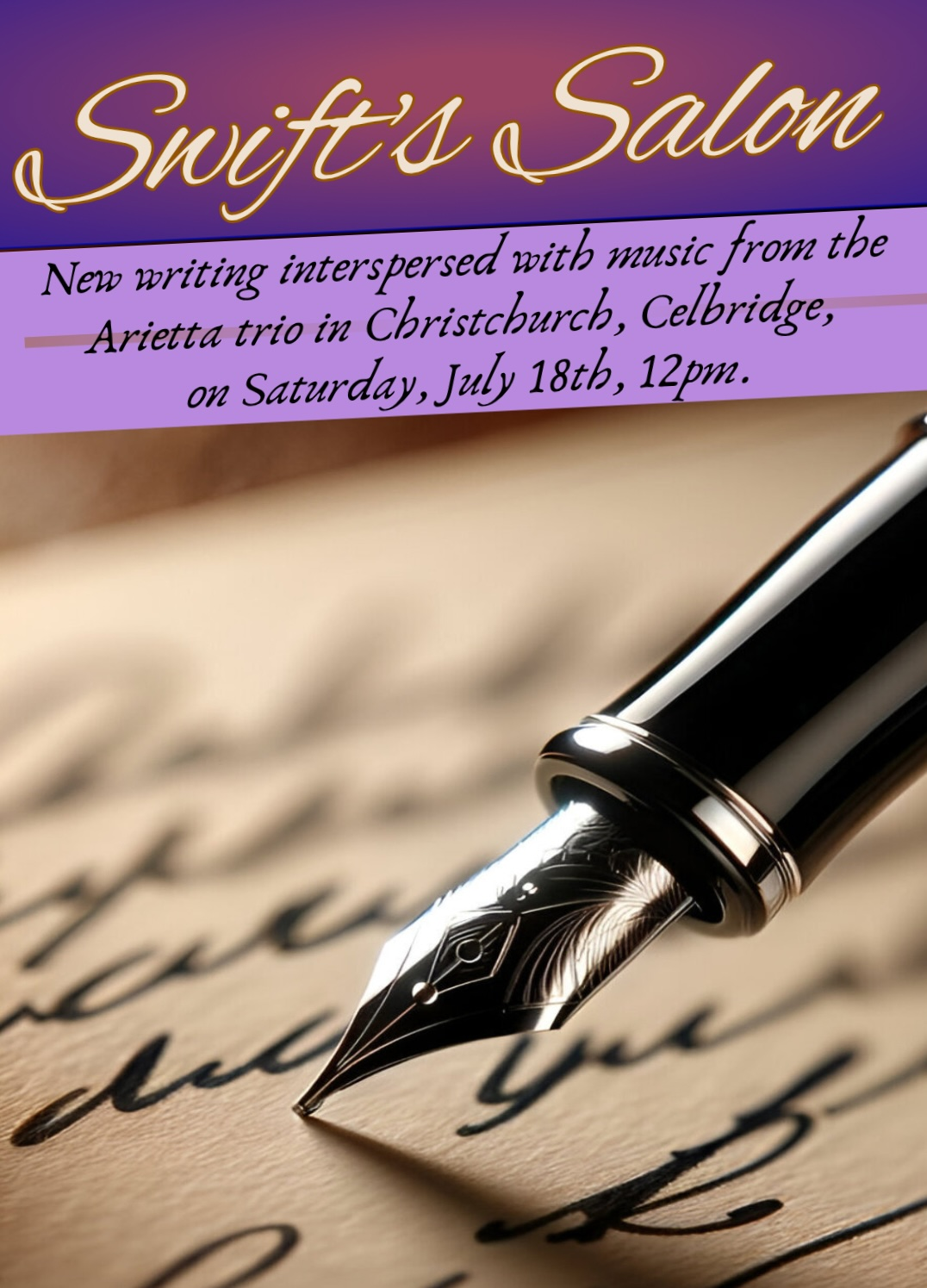
The piece I’m reading is a new short story written specifically for the festival. It follows a person trying to make their way from Ireland to a wedding in Japan. Each encounter along the way challenges the cynical outlook that has been holding them back. After the event, I’ll publish the piece on my website.
View the programme of events here.
New Writing
Here’s what’s new on the website since the last newsletter. I love hearing your thoughts, so let me know what you think.
 Amanda Durkan
Fiction. Barbara drifts between the room she’s in and the worlds inside her head, while Colm tries, and fails, to reach her.
 Amanda Durkan
Poetry. A sound-driven poem about memory, misery, and trying to keep moving.
 Amanda Durkan
Fiction. An award-winning, unsettling piece about isolation, motherhood, and an unforgivable act.
From the Notebook
Some food for thought about characters:
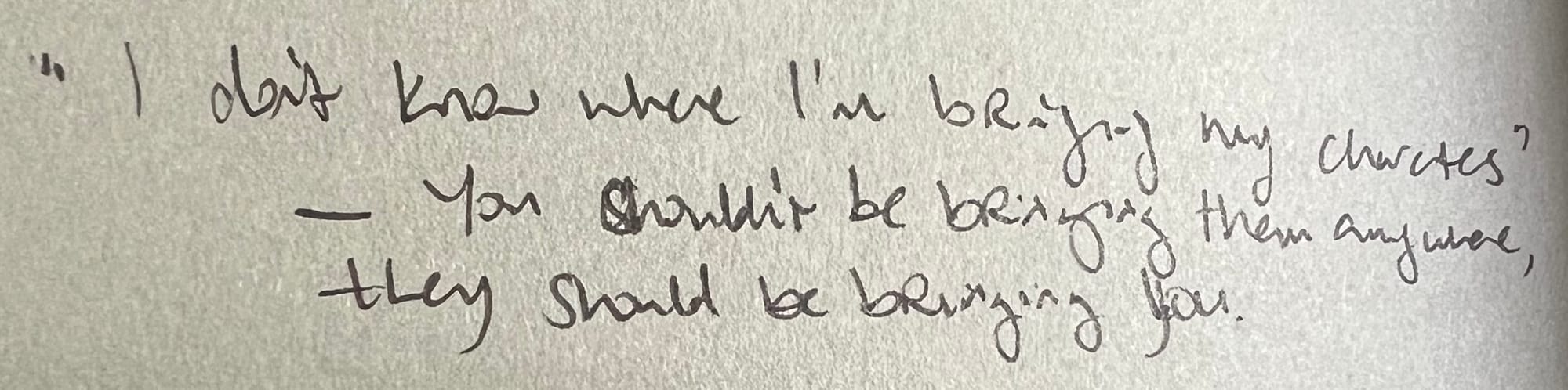
“I don’t know where I’m bringing my characters.”
— You shouldn’t be bringing them anywhere, they should be bringing you.
I wrote this down because getting to know your characters is such an important part of writing. A character should feel like a real person, with their own wants, needs, and agendas, which may differ completely from the writer’s. When a character resists what I’m trying to make them do, it usually means I haven’t understood them properly yet.
Work-in-Progress
I’m working on my novel-in-progress, a speculative fiction work with Irish influences. I’m halfway through the penultimate chapter of the first draft. It’s slow going, but I’m getting there!
It’s been a goal of mine for almost as long as I can remember to write a novel, so finally getting that first draft finished is going to be huge. My current word count is 74k, and I think the last chapter and a half will be another couple of thousand words.
On a practical note, I drafted the book in Ulysses, which has been fantastic for distraction-free writing, but I’ve now moved the manuscript into Scrivener for revision. That move feels like a small psychological shift: less “get the words down” and more “figure out what this thing actually is.”
My plan all along was to get the first draft down and come back later for editing, which I’ve mostly stuck to. Now that I’m reading it from the start, I can see there’s a lot of work to do. I knew there would be, so I’m not surprised, but I’m learning that a first draft does not a novel make. I started with a documented plan, but as the story emerged, some of those early decisions stopped working. I can already see scenes that need to be cut completely, others that need extensive rewriting, and some that need to be expanded or trimmed.
There’s a bit of a road ahead, but we’ll get there!
Writing Prompt
If you’re a writer yourself, have a go at this prompt. It’s low pressure and just for fun — write as much or as little as you like.
Write a story about a character taking a journey. Where are they bringing you?
Bonus challenge: Don’t decide the destination before you start. Let the character make one choice you weren’t expecting.
Reader Poll
Last issue, I asked: Which point of view do you prefer? First person, second person, or third person?
Last issue’s poll didn’t get enough responses for a proper result, which is fair enough for a new newsletter, so I’m calling that one unresolved for now. I’ll tell you which one I prefer, though: first person. But I do have a soft spot for the second person. There’s something interesting about a writer speaking directly to “you.”
This issue’s question is about psychic distance, or narrative distance: how close do you like to feel to a character’s inner life?
- Very close — I want to be deep inside a character’s thoughts and feelings to experience them as they happen.
- Close — I like access to a character’s inner life, but I also want room to interpret.
- Balanced — I like a mix of thoughts, actions, dialogue, and observation.
- Distant — I prefer to understand characters mostly through action, dialogue, and behaviour, with only occasional thoughts.
- External — I don’t want access to thoughts; I enjoy watching what characters do, not what they think.
- It depends on the story or genre.
What I’m Reading
I have just finished reading a duology by L.A. Cannon called Artificial Suicide. The first book is “If I Were To Die” and the second is “Would You Die With Me?” It’s an MM romance that follows two characters from a young age, Noah and Kaj, who live in Denmark. It’s an emotionally heavy series, as the titles might suggest, with topics some readers may find disturbing. This won’t be for everyone, and I’d suggest checking content warnings first, but if you like emotionally intense romance with characters who are messy, vulnerable, and trying to survive themselves as much as the world around them, you might like this.
That’s all from me. See you at the next one!